Last updated October 15, 2026
How to Hire a ADU Contractor in Orange County: A Step-by-Step Guide
In 2024, the California Contractors State License Board logged over 20,000 consumer complaints, and unlicensed or misrepresented ADU work has become one of the fastest-growing categories. The contractor who gave you the lowest bid may have done so because his crew isn’t on payroll and his license is borrowed. Hiring the right ADU contractor in Orange County isn’t about finding the smoothest sales pitch. It’s about verifying the specific people, licenses, and processes behind that pitch before you hand over a deposit that often exceeds $50,000. This guide walks you through a concrete vetting sequence that filters out the roughly 40% of bids that will blow the budget or the timeline, and you can explore more guides & resources once you’ve mastered these steps.
Quick Answer
Hiring an ADU contractor in Orange County starts with verifying a current CSLB license online, then confirming who exactly will show up at your property, and finally locking five specific clauses into a written contract: scope freeze, lien waiver schedule, change-order approval, milestone-based payments, and warranty terms. A legitimate contractor will give you fixed line-item pricing, pull permits, and put a specific crew name list in writing. Anyone who hedges on any of these three items should be disqualified immediately.
Table of Contents
- How to Verify a CSLB License in 90 Seconds
- Why You Need the Names of the Workers Coming to Your Property
- The Five Contract Clauses That Must Be in Writing
- Red Flags in the Estimate Itself
- How to Cross-Reference References With Specific Questions
- Orange County Specifics: Permits, Setbacks, and Coastal Rules
- Prefab vs. Stick-Built: Which Fits Your Orange County Lot
- Common Mistakes to Avoid
- When to Call a Professional
- Frequently Asked Questions
- The Bottom Line
How to Verify a CSLB License in 90 Seconds
Every contractor doing ADU work in Orange County must hold a valid California Contractors State License Board (CSLB) license. The check itself takes less than two minutes online. Go to the CSLB license lookup page, enter the company name or license number, and confirm three things: the license status says “Active,” the classification covers residential building (Class B General Building is the standard for ADU work), and the license has not been suspended. You want to see zero active arbitration claims against the contractor, as those signal disputes that have already escalated past the conversation stage.
The nuance most homeowners miss is the distinction between an RMO (Responsible Managing Officer) and a qualifying individual who is merely paperwork. An RMO is an actual employee of the company who holds the license and is legally responsible for the work. If the named licensee is an RMO who never visits job sites and has no relationship with your project, you’ve lost a meaningful layer of legal protection. Ask directly: “Is the license holder an employee, and will they be involved in my project?” A contractor who stumbles on this answer is telling you something.
In Orange County, we’ve also seen a pattern where out-of-area contractors price ADUs aggressively low, then struggle to get inspections through local planning departments. A license is statewide, but a contractor’s understanding of local codes is not. Ask whether the contractor has pulled permits in your specific city. An ADU builder in Orange County who has handled projects in Irvine, Santa Ana, Anaheim, and Huntington Beach will know that each city interprets state ADU law slightly differently on parking, height, and setback waivers.
Why You Need the Names of the Workers Coming to Your Property
You aren’t hiring a company. You’re hiring people. The company name on the proposal tells you nothing about who will be at your front door at 7 a.m. for 12 weeks straight. This is the question that separates legitimate ADU contractors in Orange County from the ones who run into lawsuits: ask for the names and roles of the specific workers assigned to your project, before you sign.
A real answer sounds like: “Javier is our lead framer, he’s been on our payroll for 6 years. Mike handles electrical, he’s a licensed electrician. Denise is your project manager, she’s your single point of contact.” A weak answer sounds like: “We have great crews, don’t worry.” The weak answer means the contractor is pulling day labor from a parking lot or subbing the entire job to an undocumented crew he’s never met. Under state law, the person who pulls the permit is responsible for the work, but that legal responsibility doesn’t help you when strangers are walking through your bedroom hallway.
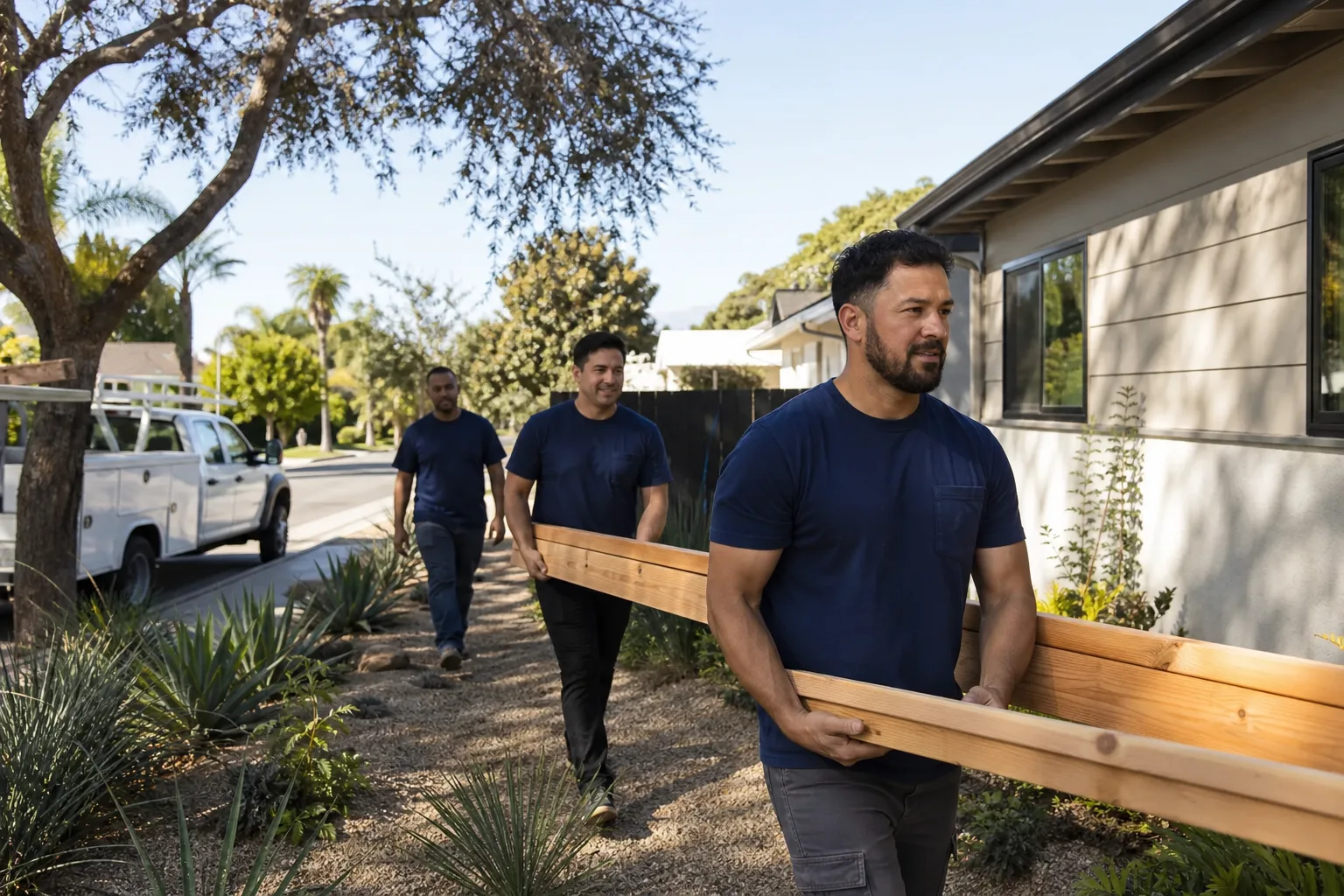
The security dimension here isn’t hypothetical. Homeowners in Orange County are often home alone, have young children, or are older adults who choose a builder specifically because they can verify who is coming. At Sutton ADU Orange County, every field technician is background-checked, identity-verified, uniformed, and photo-badged under what we call the Threshold Standard. Their name and photo are sent to you before they arrive. We don’t do this because it’s a nice perk. We do it because the alternative, letting an unvetted person enter an occupied home for weeks, is the exact scenario that generates CSLB complaints. Sutton ADU Orange County has operated under this system since 2006.
The Five Contract Clauses That Must Be in Writing
A verbal handshake is how ADU projects in Orange County go sideways. Here are the five clauses that belong in your written contract before any deposit changes hands:
- Scope freeze: A written list of every element included in the price, down to the paint brand and the number of electrical outlets. If it isn’t in the contract, it isn’t in the price.
- Lien waiver schedule: A clause requiring the contractor to provide signed lien waivers from every subcontractor and supplier before each payment is released. This is the only thing that prevents you from paying the contractor in full and then being sued by the tile supplier who never got paid.
- Change-order approval process: A written rule stating that any change to scope must be documented, priced, and signed by you before the work begins. No verbal “we had to move the plumbing line, it’ll just be a few grand more.”
- Milestone-based payments, not date-based: Tie every payment to a specific deliverable: “Foundation poured and approved by city inspector” releases 20%. “Framing inspection passed” releases another 25%. Never pay on a calendar schedule. Pay on proof.
- Warranty terms: Exactly what is covered, for how long, and what the process is for making a claim. At Sutton ADU Orange County, our 365-Day Done Right Promise is a written guarantee: if the work isn’t right within one full calendar year from project completion, we make it right. It’s not a verbal assurance. It’s stamped on the contract.
If a contractor won’t put all five in writing, he’s not ready to manage a project that costs six figures. Whether you’re working with a home addition contractor in Orange County or a dedicated ADU specialist, the contract is the only thing standing between you and a lien on your property.
Red Flags in the Estimate Itself
Most homeowners evaluate an estimate by looking at the bottom-line number. That’s a mistake. The structure of the estimate tells you far more than the total. Here are the structural red flags that we’ve seen repeatedly on Orange County ADU projects:
- Allowances instead of fixed line items: An “allowance” is a price placeholder. “Kitchen appliance allowance: $8,000” means the contractor hasn’t picked the appliances and you’ll pay the difference when the real number comes in, which it always does. Fixed line items are the real price.
- Missing permit costs: ADU permits in Orange County run anywhere from $3,000 to $15,000 depending on the city and scope, plus school impact fees and possibly water and sewer connection fees. A bid that omits permits will have a very polite change order in month two.
- Labor rates below county prevailing minimums: A skilled carpenter in Orange County earns $45 to $75 per hour. If the bid implies labor at $20 an hour, what you’re actually buying is unskilled, uninsured, or unreported labor.
- No site work line item: The price of the ADU structure is not the price of the project. You need trenching for utilities, grading, drainage, and foundation work. Some bids conveniently leave this off and bury it later.
- Vague material specs: “Windows: standard” is not a spec. “Milgard Tuscany series, double-pane, low-E” is a spec. When the manufacturer is named, you know exactly what’s going into your walls.
The disciplined approach is to ask for a written price before any work begins, with fixed line items, no allowances. That’s our policy at Sutton ADU Orange County, and it’s not a marketing gimmick. It’s the only way a homeowner can compare bids apples to apples. If you’re looking at a room addition contractor in Orange County and a detached ADU specialist, both should be able to hand you a line-item breakdown without flinching.
How to Cross-Reference References With Specific Questions
The reference call is the most underused tool in the homeowner’s kit, because most people ask the wrong questions. “Were you happy with them?” produces a polite yes from even a mediocre contractor. The homeowner wants to be nice. Here are the questions that surface the honest answer, delivered in a friendly tone:
- “Who was your main point of contact, and did that person stay the same through the whole project?” A rotating cast of PMs means the contractor was disorganized or burning through staff.
- “Did the final price match the original contract, and if not, what changed?” Listen for phrases like “we added things we wanted” versus “they kept finding reasons to charge more.”
- “How many days total did the project run, compared to the schedule they promised?” Most people remember the gap. A 6-week overrun will come up.
- “Did the same crew show up consistently, or were there a lot of new faces?” This is the informal exit interview on worker vetting.
- “If something went wrong after completion, did they fix it without an argument?” The answer tells you everything about the warranty reality.
- “Would you hire them again and, if not, why not?” The pause before the answer is data.
Ask for references from a project completed at least 12 months ago. The first-year failure rate on poor ADU workmanship in coastal Orange County is real, particularly with moisture intrusion in marine-layer climates like Huntington Beach and Newport Beach, so our Seasonal ADU Care for Orange County: Year-Round Homeowner’s Guide is worth reviewing after your build. A builder who did a job two months ago looks good. A builder whose client still talks warmly about the work a year later is proven.
Orange County Specifics: Permits, Setbacks, and Coastal Rules
Orange County is not one permitting jurisdiction. It’s 34 cities plus unincorporated county areas, and the state’s ADU mandates get interpreted differently from Costa Mesa to San Clemente. Here’s what you need to know up front:
Setbacks: State law requires a minimum 4-foot side and rear setback for detached ADUs. But some Orange County cities have adopted more generous local allowances, particularly for ADUs under 800 square feet. Always confirm your city’s current interpretation rather than assuming the state minimum applies. A setback, for those unfamiliar with the term, is the required gap between your new structure and the property line.
Height limits: Detached ADUs typically cap at 16 feet, but a two-story ADU can reach 18 to 25 feet if your lot and zoning allow. In older Orange County neighborhoods like Floral Park in Santa Ana or the historic districts of Orange and Fullerton, expect stricter height and design review.
Coastal zone rules: If your property sits inside the California Coastal Commission’s jurisdiction, which covers most of the Orange County coastline from Seal Beach to San Clemente, your ADU permit goes through a parallel review process. Budget extra time and don’t expect the project to move at inland speed.
Impact fees: Orange County ADUs under 750 square feet are exempt from impact fees under state law. ADUs larger than 750 square feet are charged proportionally. Confirm this with your city planner before you budget.
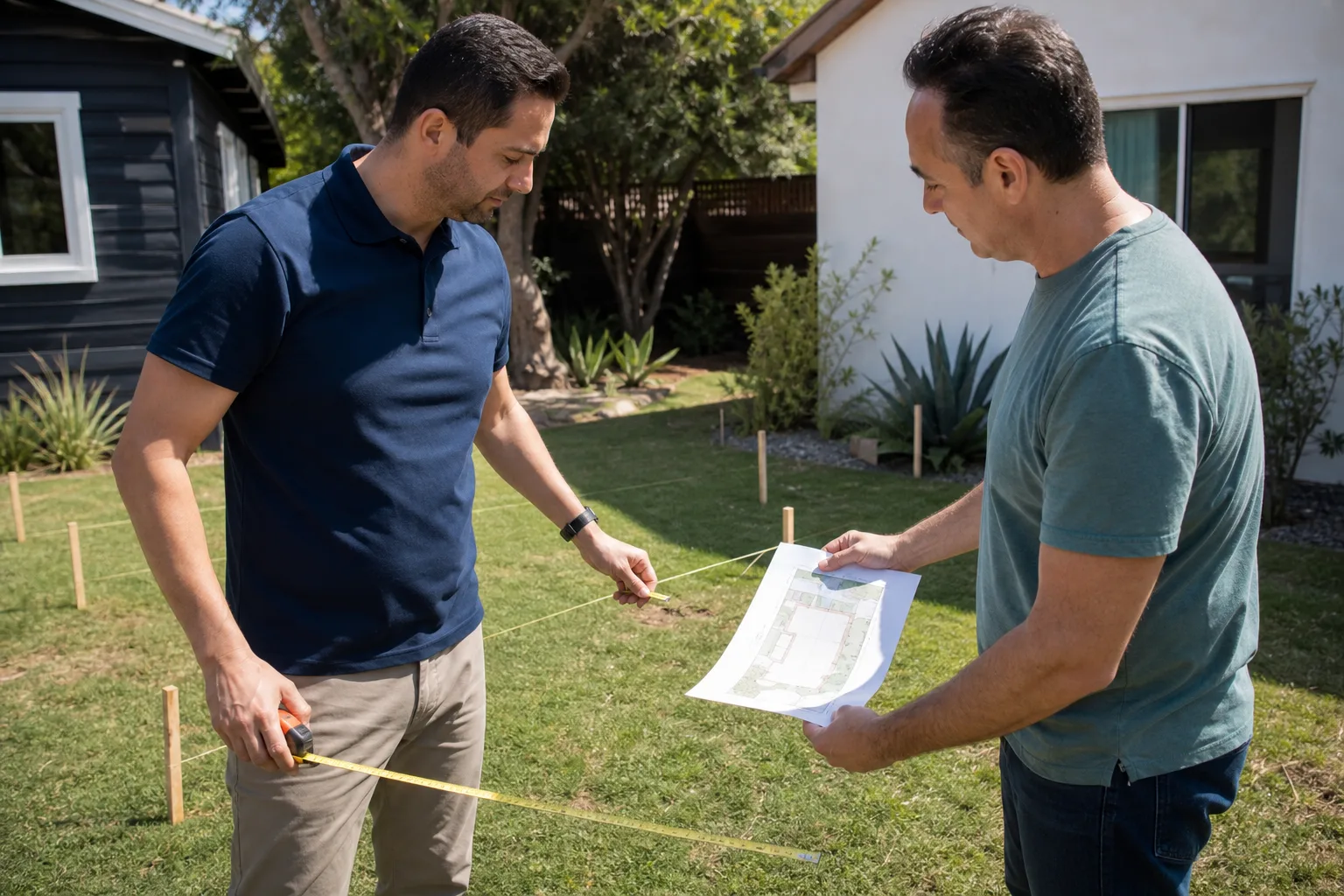
We’ve built enough ADUs across Orange County to know that the contractor’s local permit history matters more than the brochure. Ask for a list of the last five permits pulled in your city, not just in the county. It’s a reasonable request and the answer should be immediate.
Prefab vs. Stick-Built: Which Fits Your Orange County Lot
One of the more honest things we tell homeowners in Orange County is that prefab isn’t automatically cheaper or faster, despite what the marketing might suggest. The right choice depends on your lot, your access, and your tolerance for the unknown.
Prefab and modular systems like Abodu, Cover, and Dvele bring meaningful advantages to the right site: manufacturing happens in a controlled facility, the permitting path can be streamlined, and the build time on-site is shorter. Abodu in particular has a strong position in California for turnkey backyard units under 500 square feet. Cover is a good fit for tight urban lots because its panels assemble faster than stick-framing.
The honest tradeoff: prefab works best when your lot has clear crane or flatbed access from the street or alley, and when the site preparation including foundations, trenching, and utility connections is straightforward. If your Orange County lot has a steep grade, limited setback space, a tree that can’t be removed, or overhead power lines that block a crane, a conventional stick-built ADU may be pragmatically better and no more expensive. We’ve seen prefab projects in hilly neighborhoods like Yorba Linda and San Juan Capistrano run into access problems that erased the schedule advantage.
This is where hiring an ADU specialist who is fluent in both paths pays off. We’ve worked with the major prefab players and we also build conventional additions with James Hardie exterior systems, which matter in Orange County’s coastal climate. Hardie’s fiber cement cladding holds paint longer and resists the persistent moisture of marine-layer mornings in beach communities. If you ask a stick-build-only contractor about prefab, you’ll get a no. If you ask a prefab-only provider about site work, you’ll get a soft answer. Ask how we handle both, and you’ll get a straight one.
Common Mistakes to Avoid
- Choosing the lowest bid without checking the license: The low bid often means unlicensed subcontractors, no workers’ comp insurance, and a lien risk on your property. Verify the CSLB license before you open the bid.
- Signing a contract without a scope freeze: Every line item must be listed. If the contract says “ADU build” and nothing else, you’ve signed a blank check.
- Paying a large deposit up front: In California, the legal limit for a down payment is $1,000 or 10% of the contract, whichever is less. Anyone asking for 30% to “secure materials” is outside the law.
- Skipping the reference calls: Two or three specific phone calls to past Orange County clients will tell you more than any review site. The contractor should offer references without hesitation.
- Not confirming permit responsibility in writing: The contract must state that the contractor pulls all permits and that the final payment releases only after final inspection passes. If the contractor asks you to pull the permit as an “owner-builder,” run.
- Ignoring Orange County’s coastal fog: Exterior material choices in beach cities like Newport Beach and Dana Point need to account for constant moisture. Cheap trim and poor flashing show their failures fast here. Insist on material specs that withstand marine air.
When to Call a Professional
An ADU is not a weekend project. If your plan involves new foundations, any electrical panel upgrade, gas line extension, or roof work, this is a job for a licensed contractor with full permits and inspections. The stakes include your family’s safety, your property value, and your legal exposure if an unlicensed worker is injured on your property. The specific moment to call is before you buy materials, before you sketch plans, and certainly before you apply for financing. Sutton ADU Orange County offers free estimates across Orange County. Call (350) 209-9049 and ask for a written quote with fixed line items.
Frequently Asked Questions
Most detached ADUs in Orange County run between $180,000 and $320,000 before site work, depending on size, finish level, and whether you go prefab or stick-built; for a deeper dive, see our ADU Cost Breakdown: The Orange County Homeowner’s Reference for 2026. Site work including foundations, trenching, utility connections, and drainage adds another $30,000 to $80,000 in most cases. The final number depends heavily on your specific lot conditions. Call (350) 209-9049 for an exact line-item quote, and our estimates are free.
Plan on 6 to 12 months total, with the permit phase taking 2 to 4 months in Orange County depending on your city and whether coastal commission review applies. The construction phase for a stick-built ADU typically spans 4 to 6 months, while some prefab units can be placed in 2 to 3 months after site work is complete. Your contractor’s local permit history is the best predictor of the timeline.
Yes. Any garage conversion into habitable living space anywhere in Orange County requires a building permit, electrical permit, and plumbing permit at minimum. Converting without permits creates problems at sale time and can trigger enforcement action. A licensed ADU contractor should pull all permits as part of the contract.
An ADU is a fully independent living unit with its own kitchen, bathroom, entrance, and address, while a room addition expands the primary home’s footprint and shares its systems. ADUs add rental income potential, while additions add resale square footage. Both require permits, both require licensed contractors, and the decision usually comes down to whether you want a separate tenant or a bigger house for your family.
Yes, and not just any license. California requires a valid CSLB license with a classification that covers residential construction, typically Class B General Building. You should verify the license status online before signing, and confirm the license holder is an RMO who is actively involved with the company. Working with an unlicensed contractor forfeits most legal protections you have as a homeowner.
It should not, if your contract includes a scope freeze and fixed line items. The only legitimate changes come through a signed change order that you approve in writing before the work is done. If a contractor tells you the price will “probably stay around this number,” that’s not a commitment. Ask for the written price before work begins and the guarantee that covers the completed work. Call (350) 209-9049 to see what a fixed, written estimate looks like.
The Bottom Line
Hiring an ADU contractor in Orange County comes down to verifying three things before you commit: the license is active and the licensee is real, the people who will enter your home are known and vetted, and the contract contains the five clauses that protect your money and your property. Any contractor who can’t answer the reference call questions honestly has already told you what you need to know. The best builders in Orange County welcome the inspection because they’ve built their business on documented proof, not promises. That’s the standard we’ve operated under since 2006, and it’s the only way we’d choose to build on anyone’s lot.
Written by Miles Hartwell, Owner at Sutton ADU Orange County, serving Orange County since 2006.