Last updated October 15, 2026
DIY vs Professional ADU: The Orange County Homeowner’s Decision Guide
Here’s a fact most Orange County homeowners don’t learn until closing day: California will happily issue you an owner-builder permit, let you frame, wire, and finish an entire ADU yourself, and then watch your home sale fall apart because you rented that unit once. The rental triggers a state law that retroactively requires a licensed contractor to have done the work. This guide explains precisely which parts of an ADU build California law allows you to do yourself, which parts reliably cost more when you DIY, and how the current Orange County contractor pricing compares against your own time and risk. We’ll also show you the insurance and appraisal consequences nobody puts in the permit paperwork.
Quick Answer
DIY makes financial sense on an ADU in Orange County only for demolition, painting, and landscaping. The structural framing, electrical, and waterproofing phases reliably cost between 20% and 40% more when homeowner-built, once you account for rework, inspection failures, and material waste. For most Orange County homeowners, hiring a professional ADU contractor in Orange County for the whole project ends up cheaper than DIY once you factor in the rental restriction, resale complications, and the value of your own hours.
Table of Contents
- What California’s Owner-Builder Permit Actually Permits
- The Rental Restriction That Voids Your Owner-Builder Status
- The Three Phases Where DIY Saves Real Money
- The Three Phases Where DIY Reliably Increases Total Cost
- How Lenders and Appraisers Treat Owner-Built ADUs
- The Liability Exposure of an Owner-Built ADU
- A Realistic Time Budget: What DIY Costs in Hours
- Common Mistakes to Avoid
- When to Call a Professional
- Frequently Asked Questions
- The Bottom Line
What California’s Owner-Builder Permit Actually Permits
California Business and Professions Code Section 7044 says a homeowner can act as their own general contractor on their primary residence. That’s the owner-builder exemption, and it’s real. An Orange County homeowner can pull building permits in their own name, hire subcontractors directly, and perform work themselves without holding a contractor’s license.
What the permit does not permit matters more. The exemption covers construction on property you own and occupy as your principal residence. It does not authorize you to build for someone else, and it does not permit you to construct a unit specifically intended as a rental. The moment the structure’s purpose shifts from “occasional use by the owner’s household” to “income property,” the legal foundation of the owner-builder permit shifts with it.
There’s also the matter of subcontractors. An owner-builder acting as their own general contractor can hire licensed tradespeople directly. But an owner-builder cannot hire unlicensed workers and pay them wages without becoming an employer subject to workers’ compensation requirements. Many Orange County homeowners who self-build discover this when they hire a day laborer and then learn they have no workers’ comp coverage if that person is injured on the site.
And the construction itself? The state allows owner-builders to do their own electrical, plumbing, and structural work on the project, provided the work passes inspection. But passing inspection on ADU-grade electrical and structural work without trade training is not a weekend project. Orange County building inspectors apply the same code standards to owner-built ADUs as to contractor-built ones. They do not grade on a curve for homeowners.
The Rental Restriction That Voids Your Owner-Builder Status
Here’s the part most Orange County homeowners learn too late. California law says an owner-builder can construct a unit for themselves or their immediate family. The “immediate family only” occupancy restriction is not a suggestion printed on the permit; it’s a condition baked into the legal standing of the exemption itself. Place a rental listing for your new ADU, sign a lease, accept a rent payment, and you have just triggered licensed contractor requirements retroactively.
The consequence is not a fine. It’s a title defect nobody discovers until escrow. When you go to sell a property with an owner-built ADU that has been rented, title companies and buyers’ lenders may require proof that the work was performed by a licensed contractor. If you cannot provide that proof, the sale can stall or collapse. Some sellers are forced to complete a “reconstruction” of the unit with a licensed contractor before the buyer’s lender will fund.
This is not hypothetical. In our experience across Orange County, we have seen refinances delayed and sales renegotiated over exactly this issue. Homeowners who saved $30,000 on labor with a self-build have spent $15,000 on remediation and three months of carrying costs trying to close a sale. The math did not work out.
If your plan for the ADU includes rental income at any point, the owner-builder path is closed to you in practice, not just in theory. The law does not care whether you intended to rent it when you pulled the permit. It cares whether you did.
The Three Phases Where DIY Saves Real Money
There are parts of an ADU build where homeowner labor genuinely saves money without creating risk or rework. These phases share three characteristics: they do not require code-inspected skills, mistakes are cheap to fix, and the work is time-intensive rather than expertise-intensive. Orange County homeowners who do these three phases themselves and hire a professional for the rest typically save between $15,000 and $30,000 depending on the size of the project.
1. Demolition
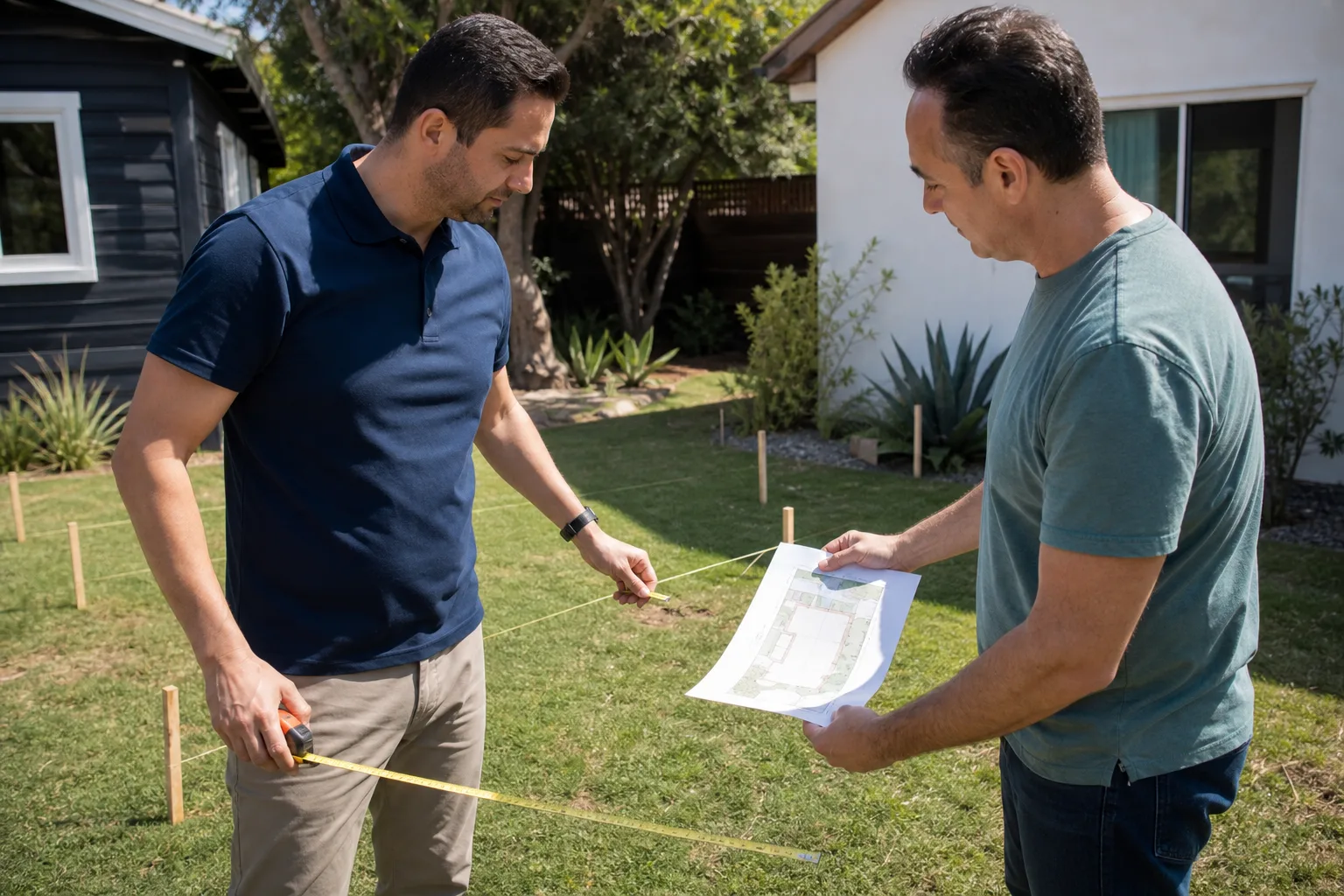
If you are converting a garage or tearing down a patio cover, demolition is mostly labor. Renting a dumpster in Orange County runs $400 to $800 for a week. A contractor will charge $3,000 to $8,000 for the demo and hauling on a typical garage conversion. Doing the non-structural demolition yourself, carefully, with the necessary precautions around any wall that could be load-bearing, is realistic savings. A young, physically capable homeowner can demo a two-car garage interior in a weekend. The savings are real, the skill requirement is low, and the inspection risk is minimal if you check with a structural engineer before removing any wall.
2. Painting
Interior and exterior painting is the single highest-margin scope item in any Orange County construction bid. Contractors charge $4 to $8 per square foot of wall area, and the paint itself costs $0.60 to $1.20 per square foot. On a 500-square-foot ADU, painting labor is a $6,000 to $10,000 line item, and the homeowner can complete the job in three to four focused weekends. The quality difference between a homeowner who watches a few videos and a professional painter is real, but the cost difference is larger. If you are patient and detail-oriented, paint it yourself.
3. Landscaping and Hardscape
The area between your new ADU and the property line does not require a contractor. Plant selection, irrigation, pavers, gravel paths, these are all self-performable. Orange County nurseries will help you select drought-tolerant plants that satisfy any local water-efficiency requirements, and the labor savings on a modest landscape package run $5,000 to $12,000. This is also the phase where homeowner taste matters most, and no contractor can read your mind about how you want the garden to feel.
The Three Phases Where DIY Reliably Increases Total Cost
There are three phases of an ADU build where homeowner labor consistently produces rework, failed inspections, and higher total cost than a professional bid. These are the phases where expertise, not effort, determines the quality of the outcome. Across Orange County, we’ve seen the same pattern repeated: a homeowner tries to save $8,000 on framing and spends $18,000 fixing it. For year-round ADU maintenance guidance, proper construction from the start matters even more.
1. Electrical
ADU electrical work in Orange County requires a service panel assessment, new circuits, AFCI and GFCI protection, and compliance with California’s Title 24 energy code, which mandates specific lighting controls and ventilation systems. A licensed electrician will install, label, and test the system in three to five days. An owner-builder will spend two weeks, buy wire and breakers at retail rather than contractor pricing, fail the rough-in inspection once or twice, and still end up hiring an electrician to fix the deficiencies. This is not a criticism of homeowner effort. Electrical code is a language, and fluent speakers do the work faster and cheaper even when they charge $90 to $140 an hour.
Safety note: Working in a live electrical panel is genuinely dangerous. Arc flash can kill. If you do nothing else, do not do your own panel work.
2. Structural Framing
Framing is where the building becomes a building, and it is also where Orange County inspectors are strictest. Seismic bracing, shear walls, hold-downs, Simpson hardware schedules, and the specific nailing patterns required by California’s seismic code are not intuitive. A professional framer learns these over years and still occasionally misses a detail. A homeowner reading plans for the first time will miss multiple details. Each missed detail is a failed inspection or a structural deficiency that has to be opened up and corrected. We have seen homeowner-framed walls that had to be partially torn down because the hold-downs were installed incorrectly, and the fix cost more than hiring a framer would have in the first place.
3. Waterproofing
ADUs in Orange County contend with winter rain, marine-layer humidity near the coast, and the occasional heavy storm. Waterproofing is the phase where mistakes are invisible for months or years, and then they appear as rot, mold, and structural damage. Flashing details, window pan flashing, shower pan liners, and exterior moisture barriers all have to be installed exactly right. The materials are not expensive; the knowledge is. A failed waterproofing detail in an Orange County ADU is not a $500 fix. It is a $15,000 to $40,000 remediation involving demo, mold abatement, and rebuilding.
If your ADU plan includes a bathroom, kitchen sink, or laundry hookups, you are doing plumbing and waterproofing. A home addition contractor with wet-area experience is not an overhead line item. It is cheap insurance against a failure you cannot see until it is too late.
How Lenders and Appraisers Treat Owner-Built ADUs
Banks do not dislike owner-built structures because they are snobs. They dislike them because they cannot verify the quality. When a licensed contractor builds an ADU in Orange County, there is a permit history, an inspection record, a contractor’s license number, and a warranty. When an owner-builder builds the same structure, the lender sees a permit in an individual’s name and no independent verification of workmanship.
The practical consequence shows up at refinance or sale. An owner-built ADU may appraise lower than a contractor-built unit of identical square footage. Some lenders will not count the ADU’s rental income in your debt-to-income ratio if the unit was owner-built. Others will apply a higher required equity cushion. A handful of portfolio lenders will finance it normally, but the pool of lenders is smaller and the terms are less favorable.
There is also the retroactive licensing issue we covered earlier. If you rented the unit at any point, the title company may require a licensed contractor to certify the work before closing. That certification is not free. Contractors charge $2,000 to $5,000 in Orange County to inspect an owner-built ADU, document corrections, and sign a verification letter. And if the inspection uncovers deficiencies, the repair cost is on you or negotiated into the sale price.
The Liability Exposure of an Owner-Built ADU
Here is a scenario worth sitting with. You build an ADU yourself. Everything passes inspection. You rent it to a tenant. A year later, a roof leak damages the tenant’s laptop and ruins a closet full of clothes, and the tenant’s attorney discovers the unit was owner-built and rented, which means the original construction was not performed by a licensed contractor as California law requires for rental units. Your homeowner’s insurance carrier is now looking at a claim on a structure that was built under an exemption that no longer applies.
What does the carrier do? Sometimes nothing. Sometimes they pay the property damage claim and then decline to renew the policy. And sometimes they deny coverage on the grounds that the structure was not constructed in compliance with the rental-use requirement. The outcome depends on the carrier, the policy language, and the specific facts. What is certain is that an owner-built ADU with a tenant creates an insurance gray area, and gray areas are not where you want to be when the claim is six figures.
If a tenant or guest is injured, the exposure is worse. A slip-and-fall with a staircase that fails to meet current code, a deck railing that cannot hold the required 200 pounds of lateral force, a water heater without proper strapping, these are the kinds of defects a licensed contractor’s insurance and workmanship warranty cover. An owner-builder has no contractor’s general liability policy behind the work. They have their homeowner’s policy and their personal assets. Orange County plaintiff’s attorneys know how to name both.
A Realistic Time Budget: What DIY Costs in Hours
Let’s put hours on the table. A 500-square-foot one-bedroom ADU in Orange County built by a professional firm takes 6 to 9 months from permit submittal to final inspection. A homeowner self-building the entire project, nights and weekends, should expect 18 to 30 months. That is not an exaggeration. Here is the hour budget for an average-skill homeowner on a 500-square-foot detached unit:
- Demolition and site prep: 40 to 60 hours over two to three weekends
- Foundation (with hired concrete sub): 15 to 25 hours of coordination and inspection prep
- Framing including roof structure: 120 to 180 hours, assuming you do not have to redo anything
- Electrical rough-in: 80 to 120 hours, high likelihood of failed inspection
- Plumbing rough-in: 60 to 90 hours, same inspection risk
- Drywall including taping and texture: 70 to 100 hours
- Painting: 30 to 45 hours
- Flooring, trim, doors, fixtures: 60 to 80 hours
- Punch list and inspection corrections: 30 to 60 hours
Total: 505 to 760 hours. At a conservative $40 an hour for your time, which undervalues the skill-hours but gives us a floor, that is $20,000 to $30,000 in personal labor value. The professional bid range in Orange County for a 500-square-foot detached ADU currently runs $180,000 to $320,000 depending on site conditions, finishes, and whether the structure is stick-built or uses a prefab system from a company like Plant Prefab or Mighty Buildings.
The DIYer who handles the three savings phases (demo, painting, landscaping) and hires a professional for everything else saves $15,000 to $30,000 and finishes in a normal timeframe. The full DIYer trades 500 to 760 hours of their life for labor savings of roughly $60,000 to $100,000, assuming nothing needs rework. When rework happens, and it usually does on a first-time self-build, the savings shrink fast.
Prefab and panelized systems change this calculus. ADU builders in Orange County with experience in Boxabl or Mighty Buildings products can compress the on-site schedule dramatically because most of the structure is assembled in a factory where tolerances are tighter and inspection is continuous. A homeowner self-building cannot buy that schedule compression at any price. If you’re weighing the value of your own time, the prefab option is worth a serious look. We can explain the tradeoffs between stick-built and factory-built systems in plain English.
Common Mistakes to Avoid
- Pulling an owner-builder permit and then renting the unit. This is the mistake that shows up at escrow as a title defect. If the ADU will ever be rented, build it with a licensed contractor. Full stop.
- Hiring unlicensed day labor without workers’ comp coverage. An owner-builder who hires an uninsured worker becomes personally liable for workplace injuries. Orange County has no shortage of plaintiffs’ attorneys who know this.
- Assuming inspections are a formality. Orange County building inspectors are thorough and consistent. They do not pass work because you tried hard. Every failed inspection costs you time and, usually, materials.
- Skipping the structural engineer. If you are removing a garage wall or adding a second story, get a licensed structural engineer to sign off before you touch anything. The $800 to $1,500 fee is the cheapest line item in the entire project.
- Doing your own waterproofing without instruction. Shower pans, window flashing, and roof intersections are the leading cause of hidden ADU failures. If you have not been trained on the products, hire someone who has.
- Not checking your insurance policy before starting. Construction in progress on your property may not be covered under a standard homeowner’s policy. Call your carrier and ask specifically about owner-builder coverage.
- Assuming the loan refinance can wait. If you are cash-flowing an owner-built ADU and plan to refinance later, talk to a mortgage broker now about how lenders will treat the structure. It is better to know before you pour the slab.
For the security-conscious homeowner, there is one more mistake worth naming: letting an unvetted crew onto your property because the price was low. A room addition contractor who cannot tell you who will show up is a liability, not a bargain. We send the name and photo of every technician before they arrive. You will know who is at your door before you open it.
When to Call a Professional
Call a professional for the structural, electrical, plumbing, and waterproofing phases of any ADU build, and for the entire project if the unit will ever be rented or sold. Call a professional if you cannot verify who will be on your property and when. Call a professional if the thought of 500 hours of self-build labor sounds less like a hobby and more like a second job. Sutton ADU Orange County offers free estimates across Orange County, and every estimate includes a written price before any work starts. Call (350) 209-9049 to schedule yours.
Frequently Asked Questions
A detached ADU in Orange County currently runs $180,000 to $320,000 for a 500-square-foot unit, depending on site conditions, finishes, and whether you use a prefab system from a company like Mighty Buildings or Plant Prefab. Garage conversions run $120,000 to $200,000. The range is wide because Orange County lot conditions vary enormously, from flat Irvine tracts to hillside lots in Laguna Beach. Call (350) 209-9049 for a written estimate specific to your property.
Yes, if the ADU is on property you own and occupy as your primary residence, and you or your immediate family are the only occupants. The moment you rent the unit, the owner-builder exemption no longer applies and the work is legally required to have been performed by a licensed contractor.
You have retroactively triggered a licensing requirement. If you later sell or refinance, the title company or lender may require a licensed contractor to certify the work before closing. Some sales fall through over this issue. If rental income is part of your ADU plan, do not self-build.
A Tuff Shed conversion can work as a budget-conscious ADU shell, but the conversion still requires electrical, plumbing, insulation, and waterproofing to meet California code. The shell is not the project. The systems inside the shell are the project, and those are the phases where DIY error is most expensive.
A professional Orange County ADU build takes 6 to 9 months from permit submittal to final inspection. A homeowner self-building nights and weekends typically takes 18 to 30 months. If you are paying a mortgage while you build, the carrying cost difference narrows the DIY savings considerably.
It depends on your policy and whether the unit is occupied by family or tenants. Construction in progress may not be covered at all under a standard policy. If the unit becomes a rental, an injury or property damage claim creates an insurance gray area that could result in denial or non-renewal. Call your carrier before you start any DIY build.
The Bottom Line
The DIY versus professional ADU decision in Orange County is not a question of your capability. It is a question of law, time, and risk. California lets you self-build, but the owner-builder permit comes with occupancy restrictions that turn into title defects if you rent the unit. The phases where DIY saves money, demolition, painting, and landscaping, are real but limited. The phases where DIY increases total cost, electrical, framing, and waterproofing, are where the building actually becomes a building. For most Orange County homeowners, the smart move is a hybrid: do the finish work yourself, hire a professional for the structure and systems, and never touch the electrical panel. You can also explore our Home Addition Contractor Maintenance Checklist for Orange County Homeowners to keep your investment protected.
When you are ready for a written price and a crew you can verify before they arrive, call Sutton ADU Orange County at (350) 209-9049. Meanwhile, browse more guides & resources on ADU planning and construction. We will walk the property with you, explain the options in plain language, and hand you a written number before anything starts.
Written by Miles Hartwell, Owner at Sutton ADU Orange County, serving Orange County since 2006.