Last updated October 15, 2026
ADU Warning Signs: A Orange County Homeowner’s Reference Guide
The contractor who ghosts you didn’t become a ghost on day 90. He showed you three signals by day 14. You just didn’t have a reference for what they meant. Most failed ADU projects in Orange County don’t collapse in a dramatic framing error or a burst pipe. They die slowly, in two-week permit delays, in allowances that quietly override your budget, in crews that change faces every Monday without explanation. This guide is your reference, and you can find more guides & resources on our blog. By the time you finish reading, you’ll know which signs mean “fixable” and which mean “walk away now.”
Quick Answer
The most reliable ADU contractor warning signs in Orange County are pre-contract signals, not construction failures, as we detail in The Complete Guide to ADU in Orange County: an estimate full of allowances instead of fixed prices, a subcontractor list that never gets attached to the agreement, a license held under a different name than the company on the proposal, and a rush to sign before you’ve had 48 hours to read the contract. If you see any two of those four, you’re not looking at a builder with a process problem. You’re looking at a builder who gets paid whether or not the project goes well.
Table of Contents
- Pre-Contract Red Flags: What the Paperwork Tells You Before You Pay
- During Construction: When Delay Becomes Deception
- Financial Warning Signs: How Money Signals Trouble Before the Work Shows It
- Crew and Identity Concerns: Who Is Actually at Your Door
- Post-Completion Signals: What Failing Work Looks Like in the First Year
- What Orange County ADUs Actually Cost: Real Numbers for Self-Qualifying
- The Orange County Permit Timeline: What Normal Actually Looks Like
- Common Mistakes to Avoid
- When to Call a Professional
- Frequently Asked Questions
- The Bottom Line
Pre-Contract Red Flags: What the Paperwork Tells You Before You Pay
Most homeowners evaluate an ADU contractor by personality. That’s the first mistake. Personality is the easiest thing in construction to fake. Paperwork is harder. If you learn to read the documents, you’ll see problems months before they show up in drywall.
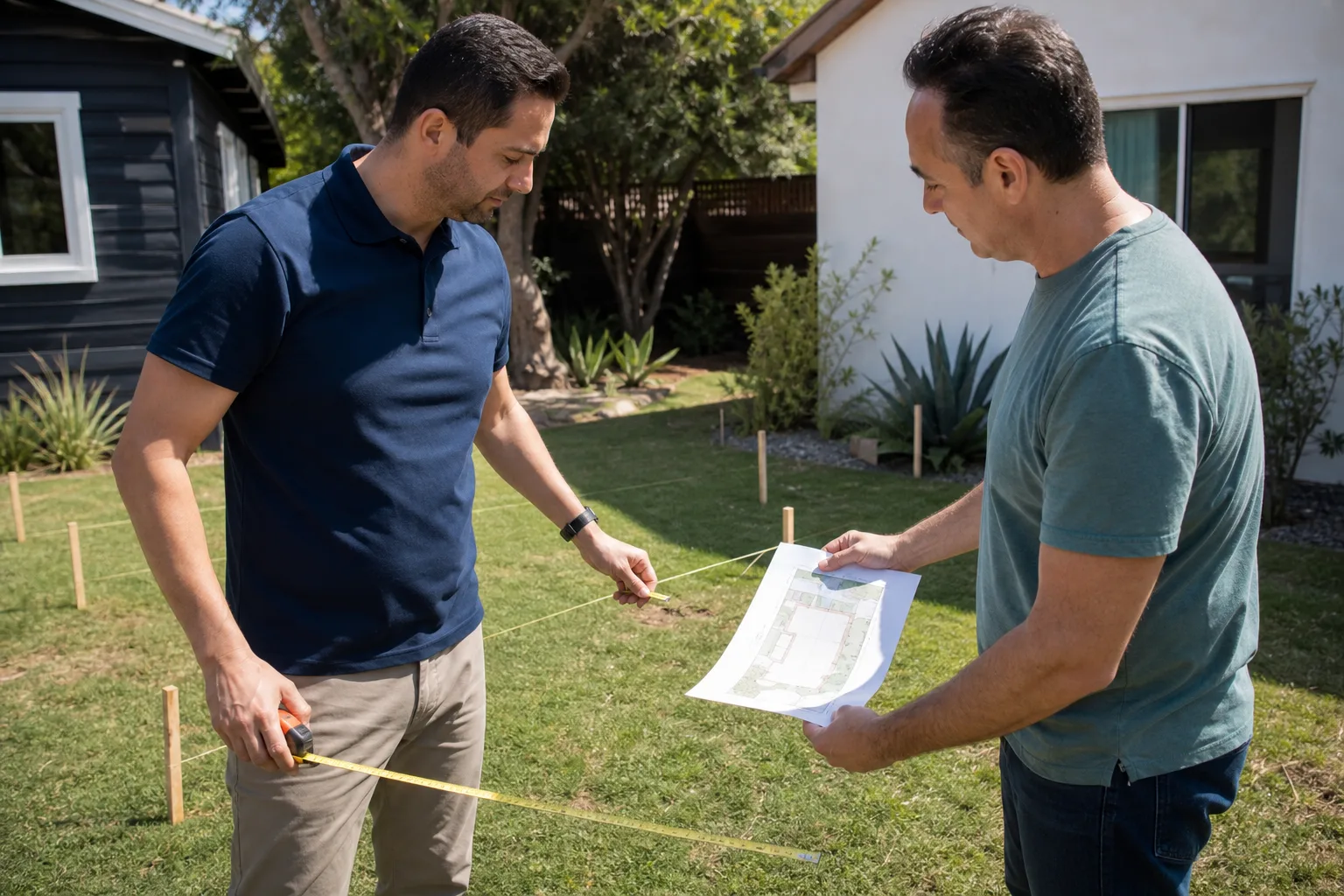
The estimate is the first place to look, and it’s the most revealing. A legitimate ADU estimate for Orange County runs eight to twenty pages. It separates site work from foundation work from framing from electrical. It names specific materials, sometimes down to the manufacturer. It lists allowances only where true unknowns exist: fixture selections, paint colors, appliance packages. And even those allowances should have a stated cap.
An estimate that arrives ninety minutes after your first phone call, with one page and three line items, is not an estimate. It’s a hook. Same-day estimates with pressure to sign are a signal that the contractor values speed of commitment over accuracy of scope. In our experience, an ADU estimate that takes less than a week to prepare in Orange County usually means someone hasn’t actually looked at your lot, your soil, your setback lines, or your utility access.
The unsigned subcontractor list. Ask for it before you sign. If the contractor hesitates, that hesitation is data. Most ADU projects in Orange County involve a general contractor coordinating four to eight trade specialists: an electrician, a plumber, an HVAC technician, a roofer, a stucco or siding crew, a drywall finisher, a tile setter. You are entitled to know who those people are, whether they’re licensed, and whether they’ve worked with this general contractor before. A builder who can’t produce the list hasn’t arranged the work yet. You’re signing a contract with a promise instead of a plan.
The license name mismatch. Check the license number on the proposal against the CSLB database. Not the company name. The license number. If the number belongs to a different legal entity than the name on the letterhead, you’re looking at one of two situations: a contractor renting someone else’s license, or a general contractor who has not updated their paperwork to match their marketing. Both are problems. Orange County has one of the highest concentrations of unlicensed contractor complaints in California, and the common thread is always a name mismatch that seemed like a clerical error.
No lien waiver schedule. A lien waiver is a document releasing your property from a subcontractor’s or supplier’s right to claim money against it. A real Orange County ADU contract includes a schedule: waivers at each milestone draw, partial and final, conditional and unconditional. If the contract doesn’t mention lien waivers, you’re signing up to potentially pay twice: once to the contractor, and again to a supplier who never got paid. This is not a rare scenario. It’s a standard failure mode for undercapitalized builders.
The Threshold Standard we run on every Sutton ADU Orange County project includes a written price before any work begins. Not a range. Not a ballpark. A line-item price. If that’s not what you’re holding when you sign, you’re holding a starting point for negotiation, and the negotiation will happen after you’ve already paid the first draw.
During Construction: When Delay Becomes Deception
Construction delays are normal. Every real builder in Orange County deals with them: inspector backlogs, material lead times, weather windows, utility coordination. What separates normal delay from a warning sign is transparency. A normal delay is announced, explained, and rescheduled with a reason. A warning-sign delay is met with vague language, shifting explanations, and a supervisor who never seems available to discuss it.
Inspections that keep getting postponed. Here’s the pattern we’ve learned to recognize, and you should too. The framing inspection is scheduled for Tuesday. On Monday, you get a text: “Inspector had a conflict, moving to Thursday.” On Thursday: “Plan correction feedback, we’re reviewing.” On Monday: “Scheduled for Wednesday.” Then Wednesday comes and no one shows. This is not a scheduling problem. In Orange County, inspection scheduling is done online through the city or county portal, and the result is posted. If your contractor can’t show you the posted result, the inspection probably failed. Failed inspections are not fatal. Hidden failures are. Ask for the inspection record. If there’s resistance, that resistance is the story.
Materials without packaging. A crew shows up with unmarked lumber. No mill stamps. No grade markings. No manufacturer wrapping on the windows. No UL listing on the electrical panel. In Orange County, where building code enforcement is strict and seismic standards are high, unmarked materials usually mean one of three things: reclaimed stock from another job, gray-market imports that won’t pass inspection, or outright salvage. Lumber should carry a grade stamp. Windows should carry a NFRC label. Electrical components should carry a manufacturer name and testing mark. If the materials arrive naked, the inspection is going to fail, or the contractor is planning to install them after the rough inspection. Either way, you’re paying for a structure that won’t perform.
The rotating supervisor. A site supervisor changes once, that’s life. People move, get promoted, take other jobs. Twice in a month, that’s a flag. The supervisor is the person who holds the knowledge of your project: the permit conditions, the inspection schedule, the change orders, the conversation from three weeks ago where you clarified the window placement. When the supervisor changes without a handoff conversation with you, the knowledge gap becomes your problem. You’ll repeat yourself. Decisions will be remade. The new supervisor will “discover” problems the old one had already solved, and those discoveries will come with change-order prices.
What normal construction looks like in Orange County. Normal is a written schedule that slips by days, not weeks, and a builder who follows a Home Addition Contractor Maintenance Checklist for Orange County Homeowners. Normal is an inspection that fails once, gets corrected, and passes. Normal is materials that arrive branded, wrapped, and documented. Normal is a supervisor who answers your call within the same day and walks the site with you when you ask. If what you’re experiencing doesn’t look like normal, it isn’t. And asking questions is not being difficult. It’s being an adult with a six-figure investment on the line.
Financial Warning Signs: How Money Signals Trouble Before the Work Shows It
Payment structure is the least romantic part of building an ADU, and the most predictive. The way a contractor wants to be paid tells you more about their financial health than any review ever will.
Cash requests. In Orange County, a legitimate contractor takes checks, ACH transfers, or credit card. They have a business account, they carry insurance, they report income. A contractor who asks for cash is avoiding something: a tax obligation, a lien, a child support order, a judgment, or all four. Cash payments are untraceable. If the contractor walks, your only record is a stack of ATM receipts. No court, no CSLB complaint, no insurance claim can help you recover cash. The request itself is the warning sign.
Draws that outpace completion. A standard Orange County ADU payment schedule looks like this: 10% at contract signing, then milestone draws tied to completed and inspected work. Foundation poured and passed: 15%. Framing complete and inspected: 20%. Roof on and building dried in: 15%. Rough electrical, plumbing, and HVAC inspected: 20%. Drywall, paint, finish: 15%. Final inspection and occupancy: 5%. If your contractor asks for 30% before any work has started, or the second draw before the first milestone has passed inspection, they’re financing their cash flow with your money. That’s what the draw schedule is for: it protects you from exactly this scenario. A contractor who pushes the schedule early is telling you they’re short.
Material cost increase clauses with no cap. Read this sentence carefully, because it’s buried in contracts all over Orange County: “Contractor reserves the right to increase the contract price to reflect increases in material or labor costs.” Now read the next sentence, the one that should follow and often doesn’t: “provided that no single increase shall exceed 5% of the contract price and all increases shall be documented with supplier invoices.” If the second sentence is missing, you’ve signed an uncapped escalation clause. Material prices do move. Lumber went up 40% in some months of 2021. But a professional builder prices that risk into the bid. An uncapped clause means you, not the contractor, carry the risk. And you don’t get to see the invoices.
We wrote the Sutton ADU Orange County pricing model specifically to remove this game. A written price before work begins. Not an estimate that floats. Not allowances that expand. A price. If the job costs more because we missed something during planning, that’s our miss. Not your invoice.
Crew and Identity Concerns: Who Is Actually at Your Door
You’ve handed over a deposit and your home address. You’ve scheduled months of construction. You’ve told your family that workers will be on the property. Then a truck pulls up and four men get out, and none of them match any name on any document you’ve ever seen. That moment is a warning sign. But the truth is, it’s also the moment when most homeowners decide not to ask. The social discomfort of questioning someone’s legitimacy outweighs the security concern. Contractors know this. Some rely on it.
Names that don’t match the contract. Your contract should name the licensed tradespeople who will perform the work. If the electrician who shows up is not the electrician on the subcontractor list, ask why. The answer matters. A legitimate substitution happens: someone gets sick, another job runs long, a licensed professional sends a qualified apprentice under supervision. The key word is “supervision.” In California, a licensed electrician can supervise one apprentice or trainee. If three unlicensed workers show up with no licensed journeyman on site, that’s not a substitution. That’s an unlicensed crew doing electrical work on your property.
No marked vehicle. A beat-up pickup with no company name, no license number on the door, no magnetic sign, and no logo can be a perfectly legitimate independent tradesperson. Or it can be a day-labor crew picked up that morning from a parking lot. The vehicle itself is not proof. But combined with other signals, no name on the truck, no uniform on the workers, no ID at the door, it starts to paint a picture. A professional ADU builder in Orange County with a real business presence has no reason to hide their name. They advertise it.
Reluctance to show ID. This one is simple. If a worker refuses to show identification when asked, you have every right to refuse them entry to your property. It’s your name on the deed and your family inside the house. A contractor who takes offense at this request is a contractor who doesn’t understand what it means to open your home to strangers. At Sutton ADU Orange County, every technician is background-checked and identity-verified. Their name and photo are sent to you before the visit. They arrive in a clean, marked uniform and show a photo ID badge at the door. Every time. We call it the Threshold Verified standard, and we built it because Orange County homeowners told us that the hardest part of a remodel isn’t the construction. It’s the trust.
Post-Completion Signals: What Failing Work Looks Like in the First Year
The warranty period is diagnostic. A well-built ADU in Orange County should be quiet for the first twelve months. No cracking, no binding, no electrical oddities, no water intrusion. If your structure talks to you during year one, it’s telling you where the shortcuts were taken.
Doors and windows that bind seasonally. Orange County doesn’t have dramatic freeze-thaw cycles like the Midwest, but we do have soil movement. Expansive clay soils, common in inland areas like Yorba Linda and Anaheim Hills, swell in winter rains and shrink in summer drought. A properly engineered foundation accounts for this movement. Doors and windows continue to operate smoothly through the seasons. When a door starts sticking in January and frees up in August, the framing is moving because the foundation wasn’t engineered for the soil it sits on. This is not a maintenance issue. It’s a structural one, and it shows up in year one.
Grout cracking within 60 days. Tile work in a new ADU should not crack grout in the first two months. Grout cracks when the substrate moves. In a new structure, the substrate moves for one of two reasons: the wall assembly wasn’t built to code, or the waterproofing membrane was installed incorrectly and the backer board is swelling. Either way, it’s a workmanship defect covered by your warranty. If the contractor blames it on “settling,” find a new contractor.
Breaker trips under normal load. An ADU with a kitchen, a bathroom, a laundry setup, and a mini-split HVAC system should have a properly sized subpanel, probably 100 to 200 amps depending on appliances. If the breaker trips when you run the toaster and the air conditioner at the same time, the electrical load was calculated wrong or the panel was undersized to save money. This is the kind of defect that doesn’t reveal itself until the unit is occupied. It’s also the kind of defect that makes an ADU unrentable.
Our 365-Day Done Right Promise exists for exactly these situations. If the work isn’t right within a full year, Sutton ADU Orange County makes it right. Written on every project. Not a verbal assurance. A named, written guarantee. If your ADU does any of the above in year one, you should not be negotiating. You should be emailing the warranty language.
What Orange County ADUs Actually Cost: Real Numbers for Self-Qualifying
Here’s the pricing conversation most Orange County homeowners never get, because most contractors don’t want to give it before they’ve met you. Consider this your reference.
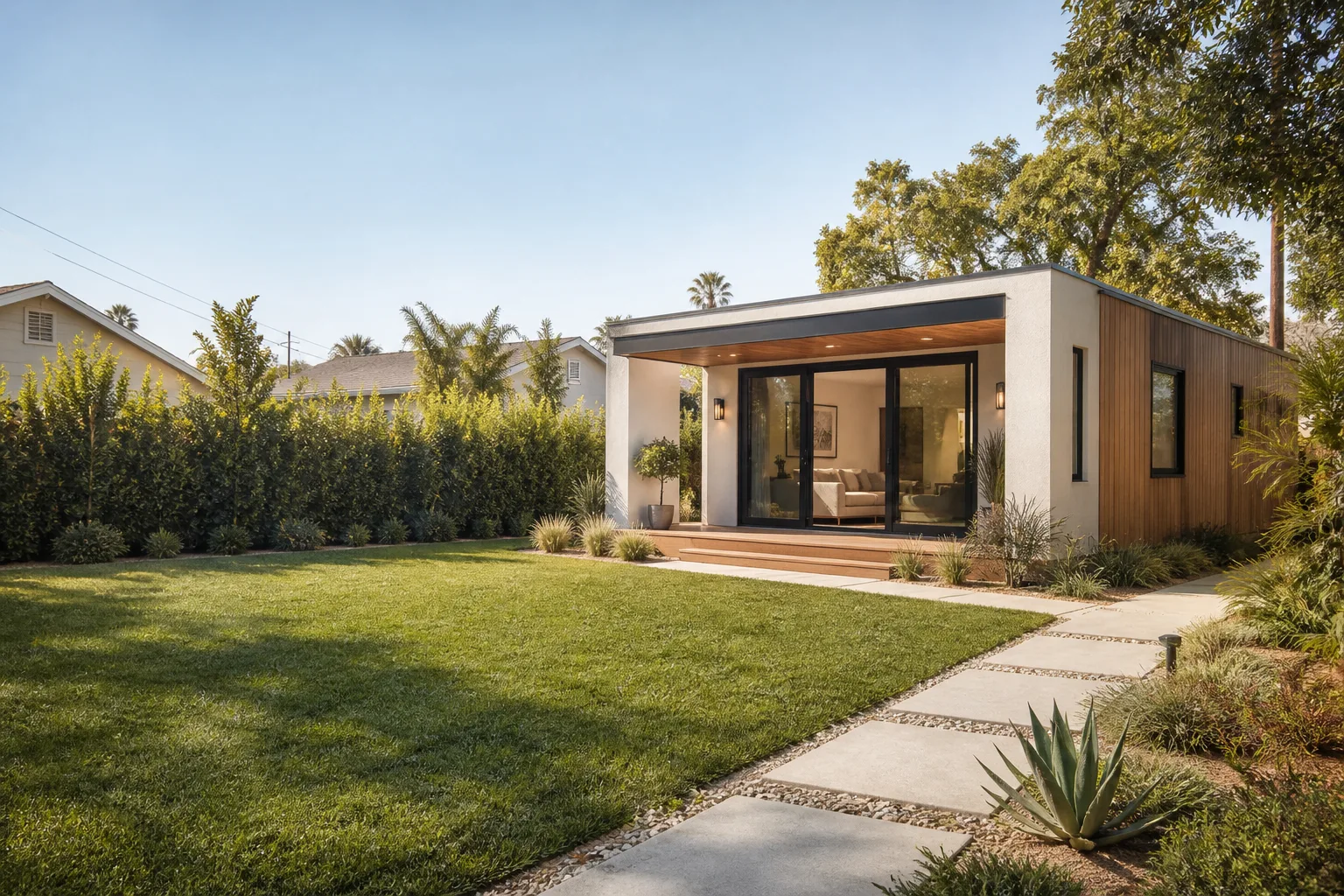
A detached one-bedroom ADU, roughly 500 square feet, in Orange County in 2025 runs $180,000 to $290,000 depending on site conditions, foundation type, and finish level. That’s the structure, the systems, the permits, the utility connections. It does not include soft costs like architectural drawings (often $8,000 to $15,000 if not bundled), structural engineering ($3,000 to $7,000), and city fees (highly variable, but expect $8,000 to $20,000 in most Orange County jurisdictions).
A two-bedroom detached ADU, around 750 to 900 square feet, runs $260,000 to $380,000. A garage conversion runs $120,000 to $200,000 when the existing structure is in decent shape, but that number can jump quickly if the garage slab is undersized, the walls are uninsulated, or the electrical service to the garage is insufficient for a dwelling unit.
Prefab and modular ADUs follow a different pricing model. Brands like Abodu, Cover, and Dvele offer factory-built units with predictable pricing and shorter on-site timelines. A typical Abodu one-bedroom unit in Orange County lands around $190,000 to $250,000 delivered and installed, excluding site work. A Dvele or Cover unit runs higher, $300,000 to $450,000 or more, because those brands target higher performance standards and more design customization. Mighty Buildings offers 3D-printed panel systems that can come in competitively but depend heavily on site preparation.
James Hardie cladding systems add material cost but reduce long-term maintenance. In coastal Orange County, where salt air eats standard stucco and wood siding, James Hardie fiber cement is often the smartest exterior choice. It runs $9 to $14 per square foot installed, compared to $5 to $8 for basic stucco.
If someone quotes you $120,000 for a 500-square-foot detached ADU in Orange County, the number is not aggressive. It’s incomplete. Either they’re leaving out the site work, skipping the permits, or planning to change-order you into the real number once the structure is up and you’re committed.
The Orange County Permit Timeline: What Normal Actually Looks Like
Permitting in Orange County confuses homeowners because it varies by jurisdiction. Each city runs its own building department. Newport Beach differs from Santa Ana. Irvine differs from Fullerton. Unincorporated areas fall under Orange County’s own building division. There is no single timeline. But there is a normal range.
Here’s what a typical ADU timeline looks like in Orange County in 2025, assuming no major plan corrections:
- Architectural and structural drawings: 4 to 8 weeks. A good designer who knows ADU code will be faster than a generalist architect.
- Plan check submission to the city: 1 to 2 weeks for initial review scheduling.
- Plan check review and comments: 4 to 10 weeks depending on the jurisdiction and workload. Some cities are faster. Some are slower. During busy construction seasons, plan check can stretch.
- Plan corrections and resubmission: 2 to 4 weeks per round. One round of corrections is normal. Three rounds means something is wrong with the drawings or the plan checker.
- Permit issuance: 1 to 2 weeks after final approval, assuming fees are paid.
- Construction: 4 to 8 months for a detached ADU from groundbreaking to final inspection.
- Final inspection and certificate of occupancy: 2 to 4 weeks, assuming no failed inspections.
Total from first design meeting to move-in: 8 to 14 months. If someone promises you a finished ADU in three months in Orange County, they’re not describing a permitted building. They’re describing an unpermitted one. And unpermitted ADUs in Orange County are a growing problem: they trigger red flags at resale, they can’t be legally rented, and in some jurisdictions, they can be force-abated.
What a slipping permit timeline shouldn’t involve is silence. A professional builder tells you when plan check comes back with comments. They share the comments. They explain the correction strategy. What a warning-sign timeline looks like is two-week increments that stretch into four-month windows, with no documentation and no explanation. “The city is backed up” is often true. But it’s verifiable. Ask for the case number. Check the city’s online portal. When a builder is honest, the facts match the story.
Common Mistakes to Avoid
- Hiring the architect and the builder separately without a coordination plan. In Orange County, the best ADU projects have the builder involved during design, not after drawings are complete. A builder who sees the drawings before they’re submitted can flag cost drivers and constructability issues before they’re baked into the permit set. A builder who meets the drawings for the first time at bid stage will price the problems, not solve them.
- Signing a contract the same day you receive it. A legitimate ADU contract deserves 48 hours of your attention. Read every page. If the contractor objects, that’s a signal. The rush is always for their benefit.
- Choosing the lowest bid without examining the scope. Three bids for the same ADU in Orange County should land within 10 to 15% of each other. If one bid is 30% lower, it’s not the same project. Something’s missing.
- Paying deposits in cash or wire transfer outside the contract. Every payment should be documented, receipted, and traceable to the contract schedule. Cash protects the contractor. Documentation protects you.
- Assuming the general contractor will pull all permits. Verify it. Ask who pulls permits, who meets inspectors, who handles plan corrections. In Orange County, the responsible party should be named in the contract. If it’s you, the contractor isn’t running the job. You are.
- Ignoring the importance of the draw schedule. Homeowners get the draw schedule wrong in both directions. Some overpay early and lose leverage. Others withhold payment at milestones that were clearly completed and damage the working relationship. The schedule is the agreement. Follow it.
When to Call a Professional
If you’re seeing two or more of the signs in this guide during an active project, call a professional third party: a construction attorney, an independent inspector, or a licensed builder who does forensic evaluation. Do not wait for the project to “turn around.” It won’t. The pattern will continue until the money runs out or the structure fails.
If you’re still in the planning phase and want to avoid the problems entirely, Sutton ADU Orange County offers free estimates in Orange County. We send you a written price before any work begins, we name your crew before they arrive, and every project carries the 365-Day Done Right Promise in writing. It’s how Sutton ADU Orange County home projects have been run since 2006. Call (350) 209-9049 and we’ll walk you through what a clean ADU contract looks like, whether you build with us or not.
If you’re considering an ADU alongside a larger project, our Home Addition Contractor in Orange County page explains how to sequence the work. For homeowners comparing prefab options against traditional builds, see our ADU Builders in Orange County overview. And if you’re on the fence between an ADU and expanding the main house, our Room Addition Contractor in Orange County resource covers the tradeoffs.
Frequently Asked Questions
A detached one-bedroom ADU in Orange County typically costs $180,000 to $290,000 including permits and utility connections, while a two-bedroom runs $260,000 to $380,000. Garage conversions run $120,000 to $200,000. These numbers assume a permitted structure with a licensed contractor, real materials, and enforceable warranties. Call (350) 209-9049 for an exact quote, because lot conditions, city fees, and soil requirements shift the number by tens of thousands of dollars.
A permitted detached ADU in Orange County takes 8 to 14 months from design to move-in, with 4 to 10 weeks of that being plan check review at the city. Any builder promising a completed ADU in under three months is not describing a permitted project. The construction phase itself runs 4 to 8 months for a typical detached unit.
The clearest signs of a bad ADU contractor in Orange County appear before construction starts: an estimate with no line items, no subcontractor list, a license number that doesn’t match the company name, and pressure to sign on the same day. During construction, watch for inspections that keep getting postponed without documented reasons, materials that arrive unmarked or without packaging, and a site supervisor who changes more than once without a handoff.
Yes. Every ADU in Orange County requires building permits, and most cities require plan check, inspections, and a certificate of occupancy before the unit can be legally occupied or rented. Unpermitted ADUs are a liability at resale, cannot be legally rented, and in some jurisdictions can be subject to abatement orders.
The 365-Day Done Right Promise is the written guarantee on every Sutton ADU Orange County project. It covers defects in workmanship for one full calendar year from project completion. If the work isn’t right, we make it right, and a second visit is always free. It’s not a verbal assurance. It’s written into the contract.
Most single-family lots in Orange County are eligible for an ADU under California’s statewide ADU laws, but setbacks (the required gap between your new structure and the property line), height limits, and lot coverage rules vary by city. The only way to know for sure is to check with your city’s planning department or have a licensed builder run a feasibility check. We do this as part of every free estimate in Orange County.
The Bottom Line
Most ADU failures in Orange County are not construction failures. They’re process failures that showed up early and got ignored. The unsigned subcontractor list. The uncapped material escalation clause. The supervisor who changed three times in a month. The draw that came early. None of these feel dramatic in the moment, and that’s exactly why they work. An ADU is a six-figure investment in the place you live. You’re entitled to a written price, a named crew, a documented schedule, and a warranty in writing. If those things aren’t on the table, nothing else the contractor says matters.
Written by Miles Hartwell, Owner at Sutton ADU Orange County, serving Orange County since 2006.