Last updated October 15, 2026
ADU Permits, Codes & Inspections in CA: What You Need to Know
Since 2020, California has rewritten its ADU rulebook four separate times, and each round of changes stripped away another layer of local control. The result is a strange moment in Orange County: state law says one thing, but some city permit counters still operate from playbooks that are three or four years out of date. Homeowners who walk in knowing the current state floor have leverage. Homeowners who don’t get told “no” for reasons that no longer exist.
This The Complete Guide to ADU in Orange County covers what the law actually requires today, where Orange County cities still push back, what inspectors look for at each stage, and which permit mistakes come back to haunt you at resale. We’ve built enough ADUs in this county to know exactly where the friction points are.
Quick Answer
California state law sets a minimum floor for ADU permits that every Orange County city must follow, including ministerial approval within 60 days, no owner-occupancy requirement through 2030, and allowance for at least one detached ADU up to 1,000 square feet on most single-family lots. Local cities can add minor design or setback rules, but they cannot legally reject a permit that meets state standards. Inspections run in three stages: foundation, framing, and final, and the most common failures in Orange County involve foundation depth, shear wall nailing, and electrical panel capacity.
Table of Contents
- What Changed in 2023: AB 2221 and SB 897 in Plain English
- State Law vs. Orange County Cities: Where the Friction Is
- The Three-Stage Inspection Sequence and What Fails Each One
- The 60-Day Ministerial Approval Rule and What to Do When a City Misses It
- Owner-Builder Permits vs. Licensed Contractor Permits
- What ADU Permits Actually Cost in Orange County
- Prefab and Factory-Built ADUs: How Permitting Differs
- Unpermitted ADUs, Title Problems, and Selling Your Home
- Common Mistakes to Avoid
- When to Call a Professional
- Frequently Asked Questions
- The Bottom Line
What Changed in 2023: AB 2221 and SB 897 in Plain English
Two bills signed in 2022 took effect in 2023, and together they represent the biggest shift in ADU permitting since the original 2020 overhaul. Understanding them matters because most Orange County homeowners get their information from neighbors who built before these laws existed.
AB 2221 closed loopholes cities were using to slow down permits. The big one: a city cannot deny your ADU application because it “doesn’t comply” with a local rule that contradicts state law. Before AB 2221, some Orange County cities would flag applications for missing design features that were never a legal requirement. Now, if state law allows it, the city must process it. The bill also clarified that front-yard ADUs are legal on lots where no rear or side yard can fit a compliant unit, and it required cities to post their ADU standards publicly rather than applying unpublished rules.
SB 897 expanded dimensional freedom. Height limits rose: an attached ADU can now reach 25 feet (or the primary home’s height, whichever is lower), and a detached ADU within a half-mile of transit can rise to 18 feet. That extra two feet over the old 16-foot standard means a livable loft or taller ceiling instead of a cramped box. SB 897 also killed the practice of cities imposing a minimum lot size for ADUs entirely, and it capped replacement unit sizes at a generous 1,000 square feet, with the option to go bigger if the primary home stays the same size.
The practical upshot for an Orange County homeowner: if your lot is small, that’s no longer a reason a city can reject you. If your ADU would be near a bus line or Metrolink station, you likely have more height than you think. And if a planner tells you something “isn’t allowed,” ask them to show you the ordinance in writing. In our experience, that single question resolves more stalled permits than any other.
Key Takeaways: AB 2221 and SB 897
- Local rules that conflict with state ADU law are unenforceable, and AB 2221 requires cities to process applications accordingly.
- Detached ADU height near transit: up to 18 feet, adding usable loft space.
- No minimum lot size for ADUs anywhere in California, including every Orange County city.
- Front-yard ADUs are legal when rear or side placement isn’t feasible.
- Cities must publish their ADU standards; unwritten rules cannot be used to delay or deny.
State Law vs. Orange County Cities: Where the Friction Is
Orange County is not one permit regime. It’s 34 cities plus unincorporated county zones, and each has its own interpretation of the state floor. Some have updated cleanly. Others lag, and we see the consequences in permit delays, surprise conditions, and outright rejections that shouldn’t happen.
The cities that have historically pushed hardest on ADU restrictions tend to be the ones with strong single-family homeowner associations and older planning cultures. Without naming names in a guide like this, the pattern is consistent: wealthier coastal and hillside jurisdictions impose “objective design standards” that go beyond state law while staying technically legal. The state allows cities to enforce reasonable aesthetic rules, but those rules must be objective: measurable, published, and applied without discretionary judgment. “Compatible with neighborhood character” is not objective. “Stucco or fiber cement siding in earth tones” is.
What often trips homeowners is a rule that hasn’t been updated since 2021. A planner citing a 900-square-foot maximum for a detached ADU when state law now allows 1,000 square feet. A city requiring covered parking replacement when the carport was never permitted in the first place. A fire department imposing sprinkler requirements on a sub-500-square-foot ADU that state code exempts.
Your leverage in these situations is the California Government Code. We always recommend bringing a printed copy of the current state standard when you visit the permit counter. Polite, factual, and specific. Not “I read online that…,” but “Government Code section 65852.2, subdivision (a)(6), sets the maximum at 1,000 square feet.” In our experience, the moment a planner realizes you’ve read the code, the conversation shifts from gatekeeping to problem-solving.
For Orange County homeowners specifically, being near the coast adds a layer: the California Coastal Commission may have jurisdiction in addition to your city. Coastal development permits can add 6 to 12 weeks to a timeline. Hillside lots in places like Silverado Canyon or Cowan Heights introduce grading and geotech requirements that flatland cities don’t face. And older neighborhoods laid out with narrow alleys create access challenges for prefab panel delivery that a competent contractor plans for in advance.
The Three-Stage Inspection Sequence and What Fails Each One
Every ADU in Orange County goes through the same three inspection gates regardless of city: foundation, framing, and final. What varies is what inspectors focus on, and that’s shaped by our soil, our climate, and the age of our housing stock.
Stage 1: Foundation Inspection. Before any concrete is poured, the inspector checks form placement, rebar size and spacing, anchor bolt layout, and hold-down positions. In Orange County, the most common failure at this stage is depth. Our soil is a patchwork of sandy loam, clay lenses, and in some areas expansive adobe that swells when wet. A footing poured at 12 inches where the plan required 18, because the contractor hit rock and improvised, fails inspection every time. The fix is demolition and re-pour: expensive, avoidable, and exactly the kind of thing a written scope prevents.
Stage 2: Framing Inspection. This happens after walls are up but before insulation and drywall hide the bones. The inspector checks nailing patterns on shear walls, header sizes over openings, roof tie-downs, and fire-blocking. In Orange County, the big one is shear wall nailing. Cities here enforce earthquake codes aggressively, and a shear panel nailed at 6 inches on center when the plan calls for 4 inches means pulling nails and redoing the panel. We’ve watched this single issue add a day to a framing inspection more often than any other. Termite-related wood damage is also flagged at this stage because once the walls are closed, it can’t be seen.
Stage 3: Final Inspection. This is the last gate before your certificate of occupancy. The inspector walks the finished unit checking electrical outlets, GFCI placement, plumbing fixtures, water heater strapping, smoke and carbon monoxide detectors, and egress windows. In Orange County, the three most common final failures are a water heater missing seismic strapping, a bedroom window that doesn’t meet egress minimums (5.7 square feet of clear opening), and a panel schedule that doesn’t match the actual circuit layout. Small fixes, but each one costs another inspection cycle and another week.
One more Orange County-specific note: if your property is in a wildland-urban interface zone, expect a separate fire inspection with vegetation clearance requirements. That’s common in places like Trabuco Canyon, Silverado, and parts of San Juan Capistrano.
The 60-Day Ministerial Approval Rule and What to Do When a City Misses It
State law requires every California city to approve or deny a complete ADU permit application within 60 days. That’s not a guideline. That’s a statutory deadline, and it applies to every Orange County jurisdiction without exception.
The key word is “complete.” The clock doesn’t start when you submit something; it starts when the city determines your application is complete. If a city takes six weeks just to tell you that you forgot a page, that’s not violating the law, but it is exactly the kind of delay that a thorough submission avoids. Most permit rejections are actually incompleteness notices, not denials.
Here’s the step-by-step process we follow for every ADU we permit in Orange County:
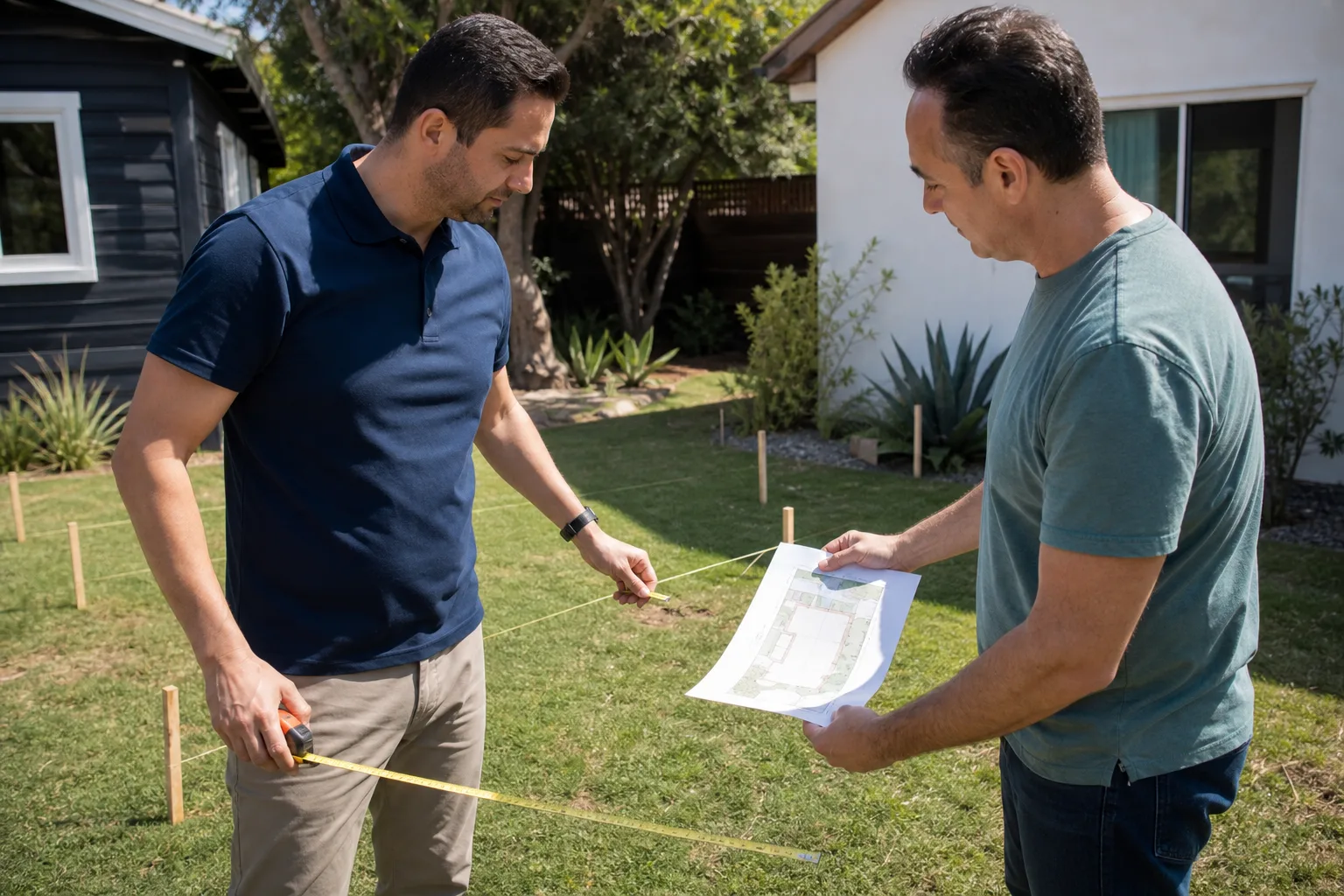
- Pre-submission meeting with the planning department. We show up with a preliminary site plan and a list of the state standards that apply. This usually surfaces any local overlay rules in 20 minutes.
- Submit a complete package. Site plan, floor plan, elevations, structural calculations, Title 24 energy compliance, and the city’s ADU checklist, all cross-checked against state code. A complete package starts the 60-day clock immediately.
- Track the calendar from the date of the completeness determination. Not from submission. If the city sends an incompleteness letter, the clock resets on resubmission.
- If 60 days pass with no decision, send a written notice referencing Government Code section 65852.2(a)(1). The application is deemed approved by operation of law. This does not mean construction is automatically authorized; you still need the building permit. But the city’s opportunity to reject the ADU as non-compliant has passed.
- Escalate to the city’s planning manager or community development director. This resolves most stalls. Cities know what the law says, and they’d rather issue the permit than defend a lawsuit.
In practice, most Orange County cities now approve compliant ADU permits in 30 to 45 days once the package is complete. But the “deemed approved” provision exists precisely because some cities historically dragged their feet. Knowing it’s in your back pocket changes the tone of every conversation.
Owner-Builder Permits vs. Licensed Contractor Permits
California allows homeowners to act as their own general contractor on an ADU: the owner-builder path. You pull the permit in your own name, hire subcontractors directly, and accept legal and financial responsibility for the build. It’s legal, it can save 15 to 20 percent on a project, and it’s the wrong choice for most people.
The owner-builder rule exists primarily for people with construction experience or unusual situations where a licensed contractor can’t reasonably take the job. Here’s what pulling an owner-builder permit actually means:
- You are the general contractor in the eyes of the law. Workers’ compensation coverage is your responsibility. If a laborer is injured on your property and you don’t have proper coverage, your homeowners insurance may not protect you.
- You absorb all warranty responsibility. A licensed contractor in California is legally obligated to stand behind workmanship for one year (and up to ten years for latent defects under the Right to Repair Act). Owner-builders have no such backstop.
- You cannot sell the property for one year without restrictions. California Health and Safety Code requires owner-builders who sell within one year to either have a licensed contractor inspect and certify the work or disclose the owner-builder status to the buyer in writing. Lenders often balk at financing an owner-built ADU sold within that window.
- Financing is harder. Construction loans and ADU-specific financing products almost universally require a licensed, bonded contractor. No major lender in California will fund an owner-builder ADU project.
When does owner-builder make sense? If you’re a retired contractor, a structural engineer, or someone who has managed multiple remodels and has standing relationships with licensed subs. For everyone else, a licensed contractor pulling the permit means the contractor’s license, bond, and insurance stand behind the work. That’s a meaningful difference when you’re spending $200,000 on a second home in your backyard.
We’re ADU builders in Orange County who pull permits under our own license on every project. It’s one of the reasons homeowners choose a licensed builder for ADU construction rather than managing the process themselves.
What ADU Permits Actually Cost in Orange County
Permit fees in Orange County vary by city, but the range is predictable. Here’s what a typical detached ADU permit package costs, based on current fee schedules across the county:
| Line Item | Typical Range |
|---|---|
| Planning / ADU review fee | $1,200 – $3,500 |
| Building permit (plan check + issuance) | $4,000 – $9,000 |
| School district fees (new construction) | $2,500 – $6,000 |
| Sewer / water connection fees (if new taps required) | $3,000 – $12,000 |
| Parking in-lieu fee (if applicable and not waived) | $0 – $8,000 |
| Fire marshal review (wildland-urban interface zones) | $500 – $2,000 |
| Total typical permit package | $11,000 – $30,000 |
Two things to understand about these numbers. First, school district fees apply to new square footage (detached ADUs) but are typically not charged on garage conversions. Second, state law waives utility connection fees for ADUs built within an existing single-family home or converted from existing space, including detached ADUs under 750 square feet. If your city tries to charge you a full new-connection fee on a small ADU, push back with the code section.
Note that these are permit costs only. They don’t include site work, utilities to the unit, or construction. For reference, most detached ADUs in Orange County in the 500 to 800 square foot range run $180,000 to $320,000 before site work, depending on finishes and whether you’re working with a home addition contractor in Orange County or going the prefab route.
Prefab and Factory-Built ADUs: How Permitting Differs
Factory-built ADUs follow a different path through the permit system, and it’s one of the reasons companies like Mighty Buildings, Boxabl, and Plant Prefab have gained traction in Orange County. These units are built in a factory under a state-approved quality control program and arrive on a truck as modules or panels.
The permitting difference comes down to what gets inspected where. A factory-built ADU carries a California Department of Housing and Community Development insignia, which means the state has already verified the structural integrity, electrical systems, and plumbing inside the factory walls. The local building department only inspects the site work: foundation, module set and connection, utility hookups, and any on-site assembly like panel joining or roof attachment.
This shortens the local inspection timeline meaningfully. A site-built ADU might see 8 to 12 trips from the city inspector over four to six months. A panelized system like Plant Prefab or a volumetric module from Mighty Buildings typically requires 3 to 5 inspections, often completed within 8 to 10 weeks from foundation to final.
But prefab is not a permit shortcut. You still need the full local ADU approval: site plan, setbacks, height check, and all the planning-level review. The factory insignia doesn’t override local zoning. What it does is shrink the construction inspection burden and eliminate most framing-stage failures, because the walls were built on a factory line with QC checklists, not in a driveway with a nail gun.
One Orange County-specific consideration: delivery. Some of our denser neighborhoods in Santa Ana, Garden Grove, and older parts of Fullerton have narrow streets and tight turn radii. A 40-foot module truck simply can’t make the turn. In those cases, a panelized system that delivers flat-packed on a standard truck works where a volumetric module doesn’t. Tuff Shed conversions face the same delivery constraints but benefit from a very light local inspection path since the structure is pre-engineered.
If you’re weighing prefab against site-built, the permit process is similar, but the inspection risk profile is different. Prefab shifts risk from weather-dependent on-site framing to factory QC. Site-built shifts it to your contractor’s framing crew. Both paths are valid in Orange County, and the right choice depends on your lot geometry and budget.
Unpermitted ADUs, Title Problems, and Selling Your Home
Here’s a scenario that plays out in Orange County weekly: a homeowner built an ADU without permits in 2015, lived with it quietly for a decade, and now wants to sell. The listing agent runs a permit history and finds nothing on file for the second unit. What was a selling feature becomes a liability.
Unpermitted ADUs create three distinct problems at resale:
- Appraisal and financing. Most lenders will not include unpermitted square footage in the appraised value, and some will flag the property as ineligible for conventional financing until the unit is retroactively permitted or removed. FHA and VA loans have explicit requirements that all structures on the property be permitted.
- Seller disclosure obligations. California law requires sellers to disclose any unpermitted work. Failing to do so is an invitation for a post-sale lawsuit. Sellers who do disclose often face buyers demanding a price reduction equal to the cost of bringing the unit to code or removing it entirely.
- Retroactive permitting is harder than original permitting. An ADU built without permits must be opened up in sections for inspection: walls removed to show framing, foundation exposed, electrical and plumbing inspected at rough-in depth. A retrofit permit can cost as much as the original build in demolition and repair.
The calculus for Orange County homeowners thinking “I’ll permit it later” should account for this reality: later is always more expensive. A permitted ADU built to code adds square footage lenders count and buyers pay for. An unpermitted one is a negotiating chip against you at best and a deal-killer at worst.
If you already own an unpermitted ADU, the path to compliance starts with an honest assessment of what’s behind the walls. In our experience, about 70 percent of unpermitted ADUs in Orange County can be brought to code with targeted corrections rather than a full teardown. The other 30 percent need so much structural remediation that removal and rebuild is the cheaper path.
Common Mistakes to Avoid
- Trusting a neighbor’s timeline. Your neighbor built an ADU in 2019 under rules that no longer exist. Permit timelines, height limits, and fee structures have all changed. Get current information, not recollections.
- Submitting an incomplete application and letting the clock restart. Every incompleteness letter resets the 60-day clock. A sloppy first submission can add two months to a process that should take six weeks.
- Assuming your city’s published fee schedule matches what you’ll actually pay. Many Orange County cities publish base fees but not connection fees, school district levies, or review deposits. Ask for a full fee estimate in writing before you commit.
- Building an ADU without checking your property’s title for CC&Rs. Older Orange County subdivisions have covenants that predate state ADU law. State law overrides most of them, but you need to know what’s on your title before a neighbor or HOA raises it.
- Choosing a contractor who doesn’t pull room addition contractor in Orange County permits in their own name. A contractor who asks you to pull an owner-builder permit while they do the work is transferring liability to you. Licensed, insured builders pull their own permits.
- Ignoring the parking replacement issue on a garage conversion. If you convert a garage that was providing required parking, some Orange County cities still ask for replacement parking. State law caps what they can demand, but you need to know the answer before you design.
- Waiting until after you pour concrete to check the setback. Setbacks are measured from the property line to the foundation edge, not the roof eave. A two-foot error at layout is a five-figure correction after pour.
When to Call a Professional
You’ve read the code. You know your city’s ADU standards. You understand the inspection stages. For more guides & resources, see our blog. At some point, the value of a professional isn’t knowledge transfer, it’s liability transfer. When a licensed contractor pulls the permit, the contractor’s license, bond, and insurance stand behind the workmanship for a full year under state law. That’s statutory, not optional.
Call a professional when the project involves structural changes to the existing home, when your lot has slope or access challenges, when the city has flagged conditions that require engineering response, or when you simply don’t want to spend the next eight months managing inspections. We handle this every day across Orange County. For a free estimate on your ADU project, call (350) 209-9049. We’ll walk your lot, review your title and zoning, and give you a written price before anything else happens. You can also learn more about our process on the Sutton ADU Orange County home page, where we lay out the Threshold Standard in detail: every technician background-checked, identity-verified, and photo-badged, with a name and photo delivered to you before anyone steps onto your property.
Frequently Asked Questions
Most Orange County cities approve a complete ADU application in 30 to 45 days, and state law caps the timeline at 60 days for ministerial review. If a city exceeds 60 days on a complete application, the ADU is deemed approved by operation of law under Government Code section 65852.2. Call (350) 209-9049 if you want a realistic timeline for your specific city and lot.
ADU permit fees in Orange County typically run $11,000 to $30,000 all-in, covering planning review, building permits, school district fees, and utility connection charges. Garage conversions and sub-750-square-foot detached units qualify for utility fee waivers under state law. For an exact line-item breakdown on your project, call us for a free written estimate.
You can physically build without permits, but the unit will be uninsurable, excluded from appraised value, and a title liability when you sell. Orange County buyers using conventional financing increasingly have deals fall apart over unpermitted ADUs. Pulling the permit is cheaper than retroactively permitting later, and retroactive permitting often requires opening walls for inspection.
California state law overrides HOA restrictions that prohibit or unreasonably restrict ADUs. HOAs can enforce architectural review for exterior appearance, but they cannot ban ADUs outright. If your HOA tries, cite Civil Code section 4751, which makes most ADU bans unenforceable.
A detached ADU is a standalone structure with its own kitchen and entrance, allowed up to 1,000 square feet on most Orange County lots. A junior ADU is a conversion of existing space inside the primary home, capped at 500 square feet, and requires no separate kitchen; permit fees are lower and the process is faster. Many homeowners build both: a JADU inside and a detached ADU in the yard.
No. California suspended all owner-occupancy requirements for ADUs through 2030. You can build an ADU on an investment property and rent out both units, and no Orange County city can legally require you to live in either one. This is one of the most underutilized aspects of current ADU law.
The Bottom Line
California’s ADU permit framework now operates with a clear premise: the state sets the floor, and local cities play within narrow lanes. Orange County homeowners who know the current state standards can push back on outdated local rules, hold cities to the 60-day clock, and move through three predictable inspection stages without surprises. The permitting path is knowable, the costs are estimable, and the liability of cutting corners is expensive and discoverable. Whether you build with a licensed contractor, a prefab system, or as an owner-builder, the single most protective decision is to permit everything, keep a written record, and choose professionals who stand behind their work.
Written by Miles Hartwell, Owner at Sutton ADU Orange County, serving Orange County since 2006.